Thursday, February 7, 2013

Day 38: Othello Word Cloud

Ooh! This one is all dark and brooding. I'm guessing the play is too. Can't wait!

From what I've read so far, though, I'm surprised the word 'honest' isn't bigger. If the play were a drinking game, you could get drunk just by taking a shot every time someone (mostly Othello) refers to "honest Iago" or "Iago's honesty." Oh the irony!

Wednesday, February 6, 2013

Day 37: Updated Reading Schedule!

I finished my reading schedule for the year! You can view it on the "Reading Schedule" tab above, or click here.

I've included some of the "disputed plays" at the end, such as The Two Noble Kinsmen and Edward III. They are "disputed" because scholars aren't entirely sure if they can be attributed to Shakespeare or not and therefore they're not in the "canon." But I'll tack them on at the end, along with the poems and sonnets.

I'm a little nervous about all of those English histories back to back, but Mike said he's looking forward to that because he knows a fair bit about English history in that time period. I'll be relying on his help come May, June and July!

I am excited to have a solid plan in place for the rest of the year (or at least until the end of September). It makes it feel more...possible.

I gave up on my original idea of reading them all in the season or time of year in which they take place. I loved the idea and I couldn't believe no one seemed to have thought of it before, but then I quickly realized there was a reason for that. Most of the plays' timelines are maddeningly difficult to pin down. Many take place over several months or years, but even the ones that take place in a shorter time period are confusing. The characters will reference both summer and winter in the same night, for instance. Or the title will lead you to believe it takes place at a certain time of the year (like Twelfth Night or A Midsummer Night's Dream), but then the play itself will reveal that it takes place at a completely different time (Twelfth Night seems to be set in the summer, even though the title suggests it takes place in January; A Midsummer Night's Dream references May Day which means it takes place on April 30, not in the "midsummer" as I had assumed was in June or July).

I don't know if the order I've picked will be the best order in which to read them or not. I guess I'll find out.

Plus, if anyone else wants to follow along with me, feel free to use the same schedule I have, or make your own. Let's do this!

Tuesday, February 5, 2013

Day 36: New Play Tuesday! Othello, the Moor of Venice

Laurence Fishburne as Othello (1995)
I'm excited to read this one for a number of reasons, not the least of which is that it'll give me an excuse to finally see Othello (1995) and O (2001). I've never read this one, but it looks complex and sexy and scary. Yay!

Plus, my partner Mike is very excited to read this because he did not like The Merchant of Venice very much, so he's planning to imagine all of the action of Othello happening in a different, less whiny region of Venice.

Monday, February 4, 2013

Day 35: What I Learned: The Merchant of Venice

Sock Monkey Merchant of Venice, by David Jones (fineartamerica.com)

The Merchant of Venice is a complicated play, made particularly complex by the fact that the cultural values of its original audience (and, one can assume, its author) are (hopefully) very different from those of modern audiences. The character of Shylock, and all Jewish characters in the play, are treated as godless outcasts and reviled villains. True, Shakespeare gives Shylock some good lines and plenty of cause to be sympathetic, but he also makes him obsessed with money and sometimes just plain evil. So Shakespeare isn't doing much to dissuade his audience from their anti-Semitism. Plus in the end, all of the Christian characters live happily ever after and all of the Jewish characters are forced to convert to Christianity and give up their personal fortunes. And those Christian characters were REALLY mean throughout the whole play, so I wasn't cheering for them to be fine in the end.

But Shakespeare's audiences would have been because his audience would have regarded Jews as villainous characters who should be reviled and, if possible, converted. So it's a difficult play to read becuase that core concept is so abhorrent. I just wished that Antonio and his friends, who had been mean anti-Semites the whole play could have gotten a little comeuppance. I wasn't rooting for Antonio to actually have to give up his "pound of flesh" (well, not really) but I didn't expect him to get to have all of Shylock's money AND his not have to pay his debt AND have his lost ships returned AND get to ride off in the sunset with his best friend (his VERY best friend, *wink wink* *nudge nudge*) his new rich wife. It's just too much reward for a character who acted like such an ass. 

I also think it's interesting that the very last scene of the play (I'm sorry if I'm ruining it for you...but it has been out for, like, 400 years now) involves Portia and Nerissa obsessing over the rings they gave Bassanio and Gratiano, until both men agree that they will treasure the rings with their lives from now on. Except that Shylock was given no end of grief for valuing too highly the ring that Jessica stole--the one that was his gift from his dead wife, no less--and was accused of being a greedy miser for it. But it's the same damn thing! Argggghhh! That part made me crazy.

Sunday, February 3, 2013

Day 34: Shakespeare Phrases! (totally not the same as Shakespeare quotes, so shut up!)

Hey! In the spirit of not having anything new to say, here's a list of famous phrases coined by Shakespeare, thanks to phrases.org.uk

135 Phrases coined by William Shakespeare

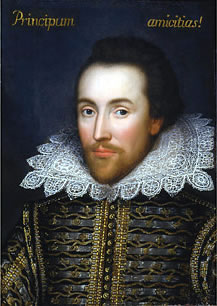
Cobbe family portrait of William ShakespeareBarry Manilow may claim to write the songs, but it was William Shakespeare who coined the phrases - he contributed more phrases and sayings to the English language than any other individual, and most of them are still in daily use.
Here's a collection of well-known quotations that are associated with Shakespeare. Most of these were the Bard's own work, but he wasn't averse to stealing a good line occasionally and a few of these were 'popularised by' rather than 'coined by' Shakespeare.

Saturday, February 2, 2013

Day 33: Shakespeare Quotes


Shakespeare Quotes

I still haven't progressed in The Merchant of Venice so I don't have anything new to say about it. Instead, why not browse some famous quotes from Shakespeare? (via AbsoluteShakespeare.com)

Sonnet 18

"Shall I compare thee to a summer's day?
Thou art more lovely and more temperate:
Rough winds do shake the darling buds of May,
And summer's lease hath all too short a date".

Hamlet

To be, or not to be: that is the question". - (Act III, Scene I).

"Neither a borrower nor a lender be; For loan oft loses both itself and friend, and borrowing dulls the edge of husbandry". - (Act I, Scene III).

"This above all: to thine own self be true". - (Act I, Scene III).

"Though this be madness, yet there is method in 't.". - (Act II, Scene II).

"That it should come to this!". - (Act I, Scene II).

"There is nothing either good or bad, but thinking makes it so". - (Act II, Scene II).

"What a piece of work is man! how noble in reason! how infinite in faculty! in form and moving how express and admirable! in action how like an angel! in apprehension how like a god! the beauty of the world, the paragon of animals! ". - (Act II, Scene II).

"The lady doth protest too much, methinks". - (Act III, Scene II).

"In my mind's eye". - (Act I, Scene II).

"A little more than kin, and less than kind". - (Act I, Scene II).

"The play 's the thing wherein I'll catch the conscience of the king". - (Act II, Scene II).

"And it must follow, as the night the day, thou canst not then be false to any man". - (Act I, Scene III)."This is the very ecstasy of love". - (Act II, Scene I).

"Brevity is the soul of wit". - (Act II, Scene II).

"Doubt that the sun doth move, doubt truth to be a liar, but never doubt I love". - (Act II, Scene II).

"Rich gifts wax poor when givers prove unkind". - (Act III, Scene I).

"Do you think I am easier to be played on than a pipe?" - (Act III, Scene II).

"I will speak daggers to her, but use none". - (Act III, Scene II).

"When sorrows come, they come not single spies, but in battalions". - (Act IV, Scene V).

Friday, February 1, 2013

Day 32: Shakespeare Lego!

I'm still slogging through The Merchant of Venice. "Slogging" is a terrible word. I'm actually enjoying it quite a bit, I'm just having trouble staying as motivated to read quickly as I had been. Maybe it's because Mike is a play behind and I can't talk about Shylock with him. Or maybe I'm just like the hare in that parable, lounging around because I feel I'm so far ahead in the race.

Either way, here, enjoy some Shakespeare lego, courtesy of mocpages.com:
Macbeth Act V, Scene 8